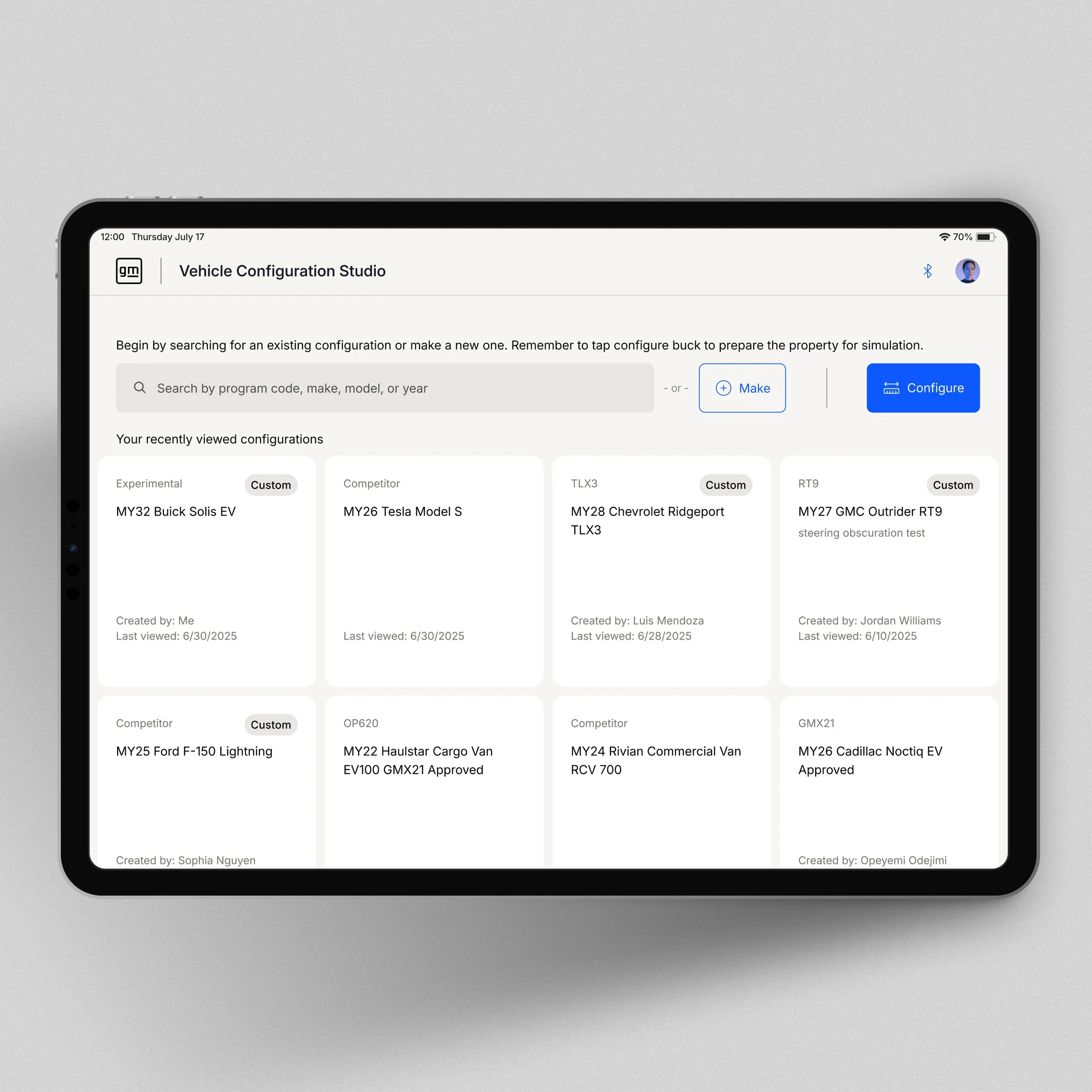
Vehicle Configuration Studio
A solution driven by users at every stage.
This is an Enterprise Design project. Due to confidentiality policies at General Motors (GM), I am only able to share limited details about applications I have designed.
A team of GM engineers created a machine that simulates vehicles, from performance cars to cargo vans.
The original request was to design desktop and tablet experiences that allow users to send data to and retrieve data from this machine. The desktop experience also required VR integration.
Overview
Priority
P0 — I would be designing for a small, high-impact user group involved in early vehicle program decision-making.
Lead Researcher — Conducted user research, synthesized findings, and presented recommendations.
Lead Designer — Owned the end-to-end design process as the primary designer on the project, collaborating with Visual and Content Design partners for specialized expertise and feedback.
Role
Timing
April – July 2025
I began by learning the machine, existing applications, and into user demographics through stakeholder discussions, demos, and app exploration. From there, I conducted research with future users.
2 Weeks | Contextual Inquiry
5 participants across:
Human Factors
Human Interface Design
Digital Experience Studio
Advanced Vehicle Development
Architectural Framing Studio
Exploration & User Research
Prioritize tablet over desktop
Users preferred tablet for leadership reviews because it was portable, easier to use, and did not require VR.
Decision: Prioritize tablet design for version 1.
Labels needed more context
Users found some terminology unclear and struggled to differentiate similar labels.
Decision: Supplement labels with additional context to improve understanding.
Keep complexity invisible
Users liked the simplicity of the existing app but wanted more functionality, fewer clicks, error prevention, and faster data input.
Decision: Design a robust experience without exposing unnecessary complexity.
Key Research Findings
Brainstorming
I explored tablet design patterns, sketched early concepts, reviewed Enterprise Design guidance, and mapped user flows.
Wireframing
Early concepts evolved into low-fidelity wireframes and prototypes in Figma. Weekly reviews with my team and stakeholder touchpoints led to continuous iteration throughout the design process.
Designing for Tablet
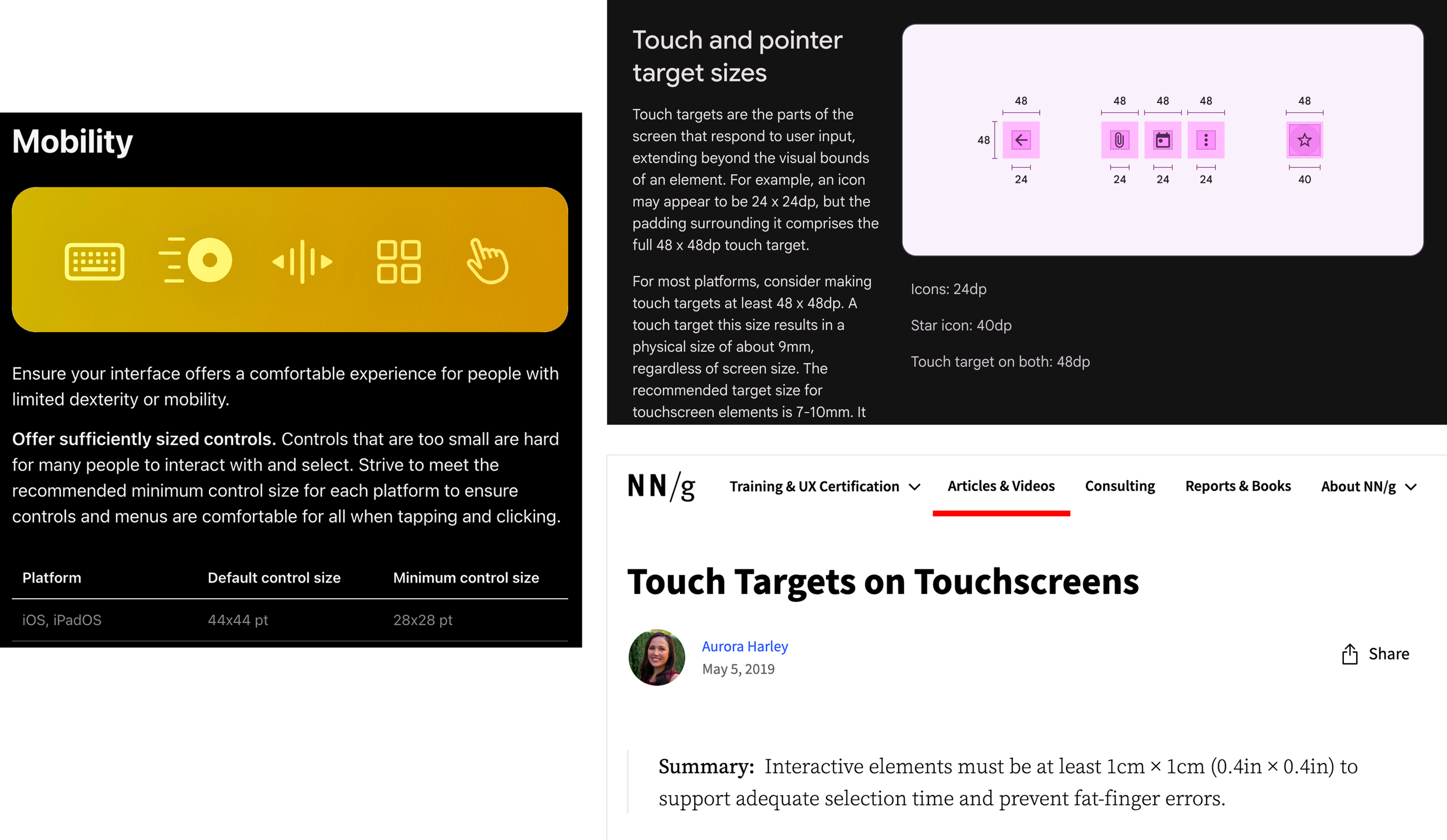
Since this was my first tablet application, I researched platform guidance and best practices before designing.
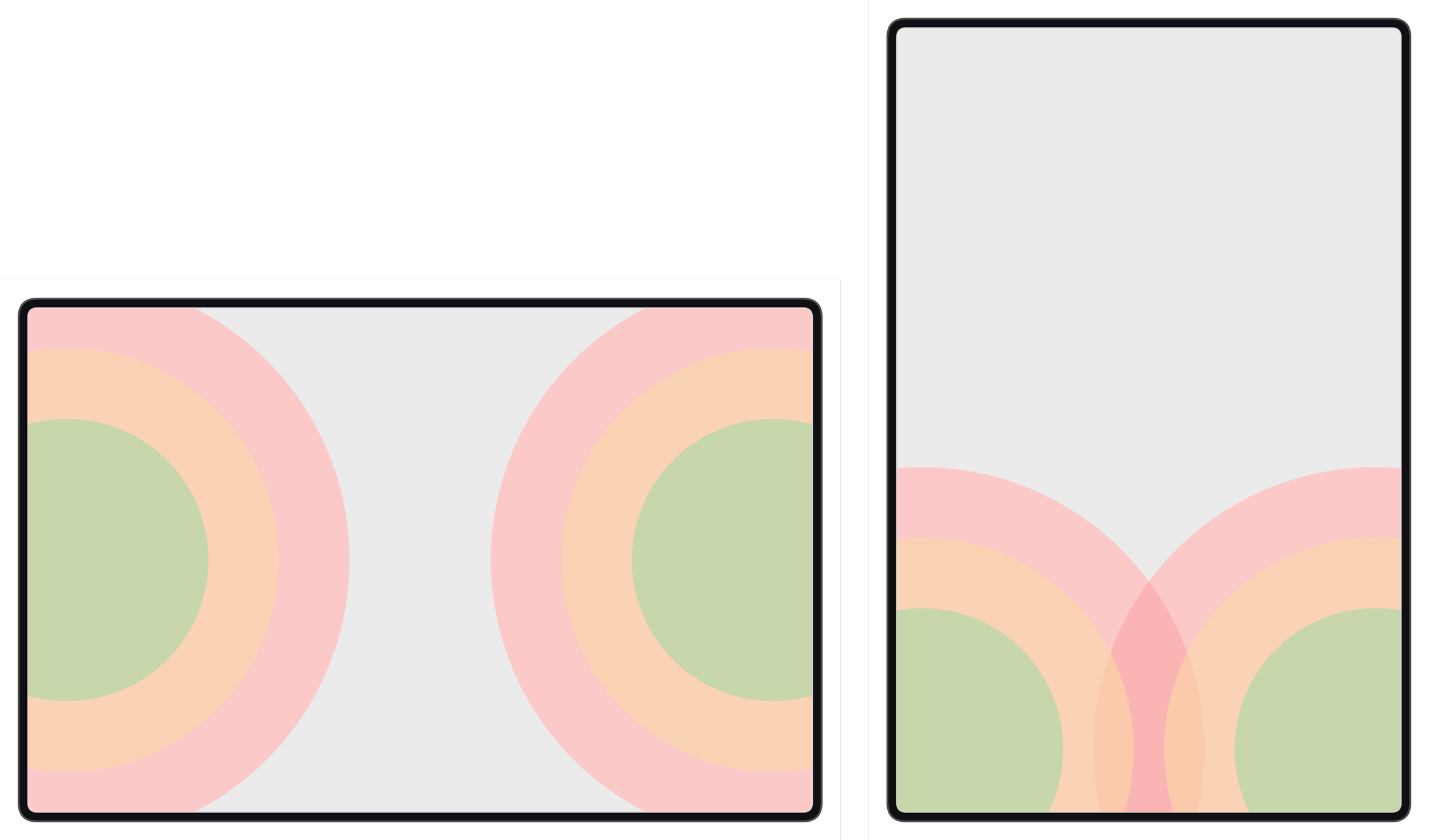
Some key considerations included:
Touch target sizing
Reachability and ergonomics
Keyboard obscuration
Defining the MVP
Although the project began with both desktop and tablet experiences, research and feature prioritization led us to focus on the tablet application for MVP.
Without documented requirements from stakeholders, my manager and I created a feature list using stakeholder conversations, research findings, and design reviews. Together with our partners, we aligned on the MVP before moving into high-fidelity design.
The application was designed for iPad Pro 11-inch (landscape).
Product Design
Qualitative Usability Testing
About one month into product design, I tested an interactive Figma prototype with users.
At this stage, visual styling had not yet been finalized, allowing the sessions to focus on:
Navigation
Task completion
Information architecture
Ergonomics
Copy
User attitudes
Testing & Refinement
Designing Without Requirements
My stakeholder partners never delivered written requirements despite multiple requests.
Rather than pause the project, I created a feature list using stakeholder conversations, user research, and design reviews. My manager and I used it to align partners on MVP scope before development.
Taking on Product Responsibilities
Early in the project, our partner team lost their Product Manager.
To keep the project moving, my manager, design PM, and I helped fill gaps in feature prioritization, planning, and coordination.
Evolving Design Guidance
During the project, Enterprise Design was actively developing new design libraries and standards.
As guidance evolved, I regularly updated the designs to reflect the latest recommendations while maintaining momentum.
Project Challeneges
Delivery
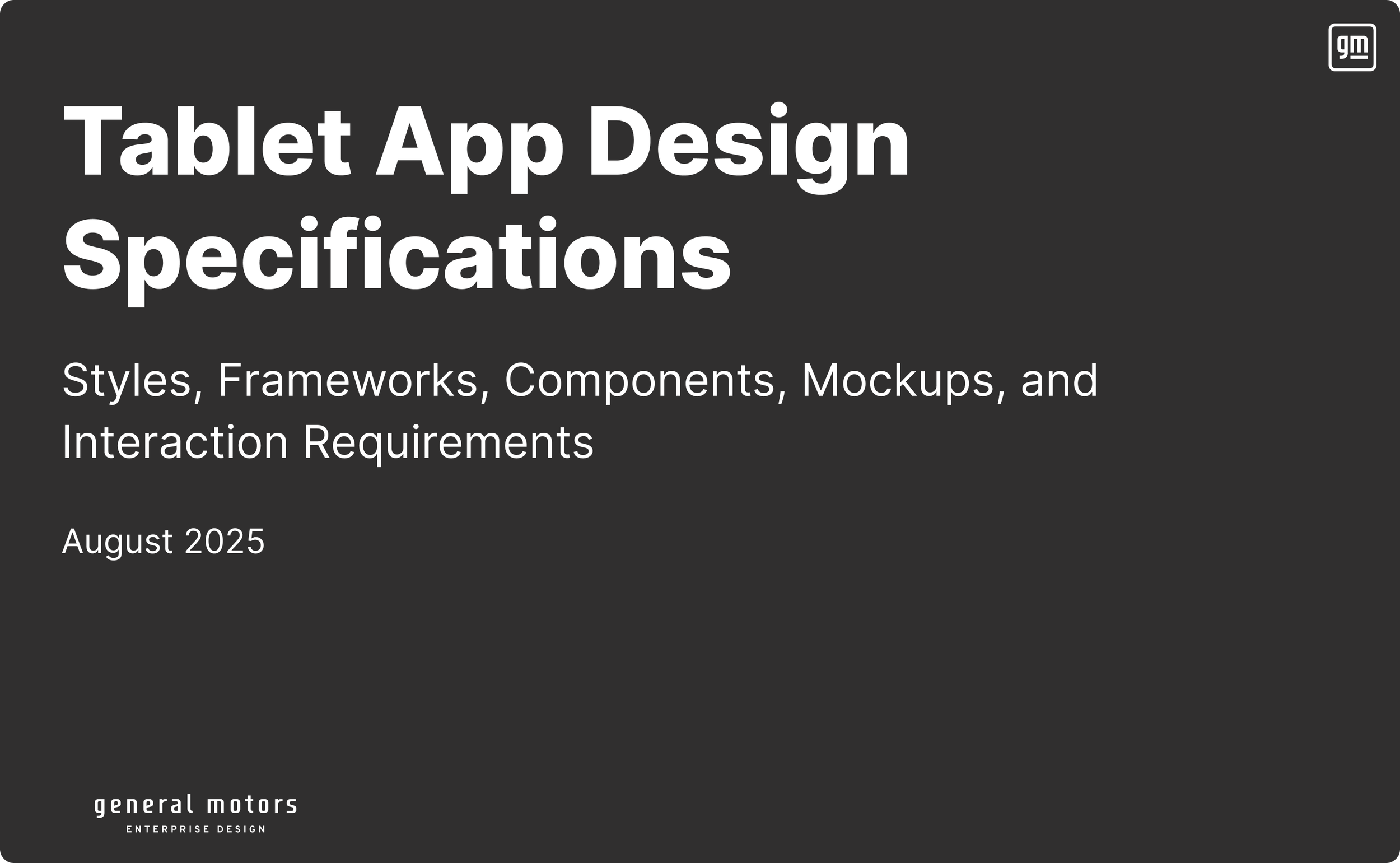
I created a comprehensive design specification for the software engineering team and presented the documentation during our handoff meeting.
Following delivery, I partnered with the team during design QA to support implementation. The application launched in early 2026 and I’m now working on designing version 2!